Visit any aesthetic clinic in Korea and you'll hear the phrase "changing the skin from its foundation." This is a fundamentally different approach from filling wrinkles with hyaluronic acid or freezing muscles with Botox. Wooyoo Laum's Tansaeng Shot (탄생주사) belongs to this "foundation-changing" category of treatment. Translated literally, the name means "birth injection" — and true to its name, it's a cocktail-style injectable treatment designed to prompt regeneration at the cellular level of your skin.
In this article, we'll walk through each component of the Birth Injection — PDRN, PLLA, and various growth factors — explain how each works, and clarify who it's for and what kind of results to expect.
What does "Skin Regeneration" actually mean?
When the word "regeneration" appears in aesthetic medicine, it carries two distinct meanings.
The first is immediate replenishment — adding what's missing from outside, the way hyaluronic acid plumps the skin. The second is activating the skin's own production capacity — stimulating fibroblasts (the cells that produce collagen and elastin) so your skin recovers its own ability to renew itself.
Birth Injection aims for the second. Rather than directly plumping the skin, the injected ingredients restart the repair and production cycle within the skin tissue. The effect appears in stages, not in a single dramatic moment. But over time, the quality of your skin itself begins to change.
The Key Ingredients and What Each One Does
① PDRN (Polydeoxyribonucleotide) — Calms inflammation while encouraging regeneration
PDRN stands for "polydeoxyribonucleotide," a low-molecular DNA fragment extracted from salmon testes. It shares roughly 95% similarity with human DNA, making it highly biocompatible and unlikely to trigger allergic reactions. It is officially approved as a pharmaceutical ingredient by both the EU and Korea's KFDA.
Originally developed for wound healing and joint regeneration, PDRN's exceptional tissue repair capabilities led to its expanded use in aesthetic medicine.
Unlike hyaluronic acid, which "fills what's missing," PDRN activates the skin's natural repair function. Acting through the adenosine A2A receptor, it can deliver improvement at the tissue level. It stimulates fibroblasts to produce collagen and elastin while simultaneously suppressing inflammation — which is why it's considered well-suited even for sensitive or reddened skin.
② PLLA (Poly-L-Lactic Acid) — Physically prompts collagen production
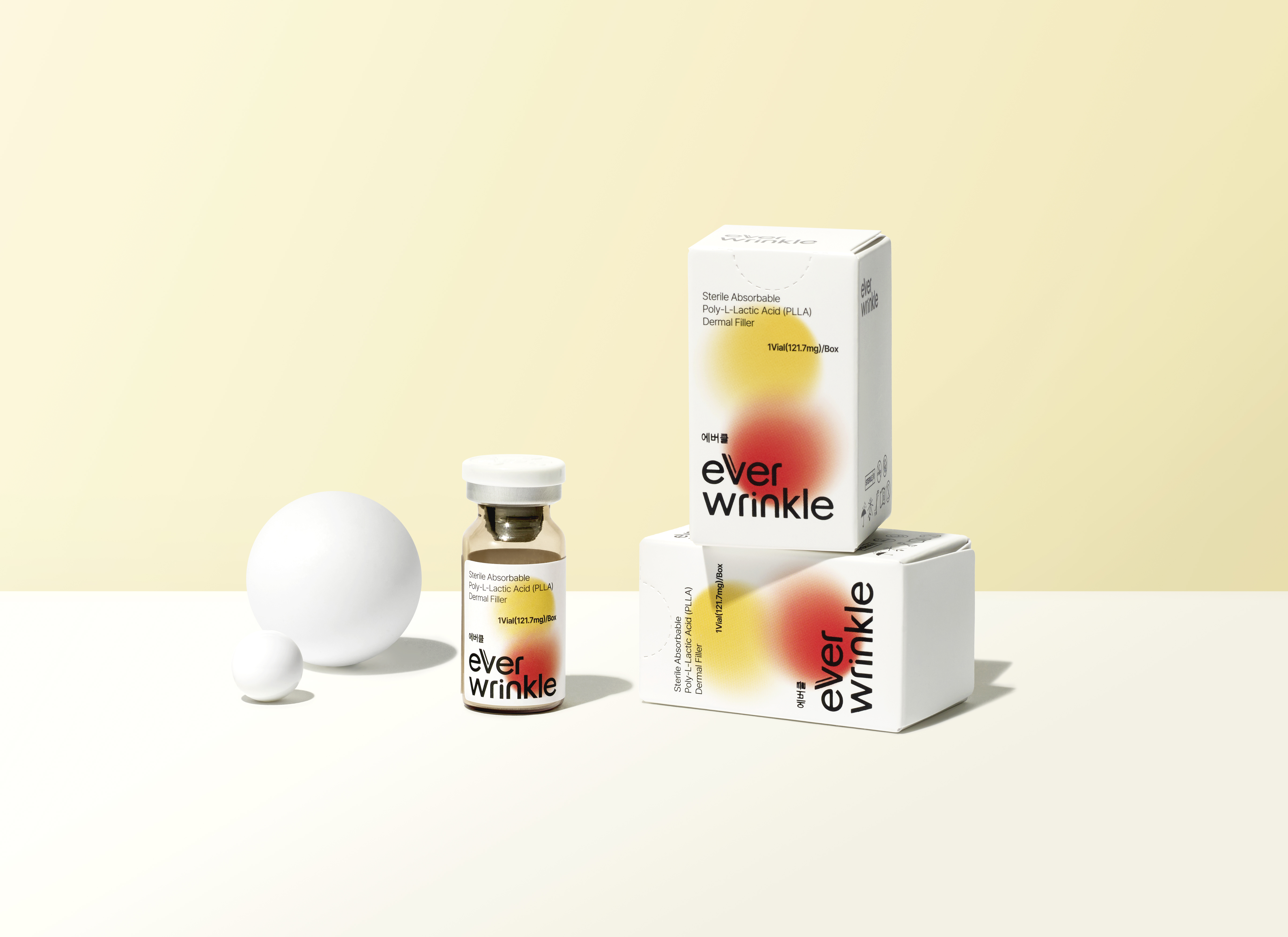
PLLA, also called poly-L-lactic acid, is a bioabsorbable synthetic polymer. It's the main ingredient in Sculptra and Juvelook, and is widely used in standalone treatments.
While PDRN sends biochemical signals to cells to prompt regeneration, PLLA acts as fine particles within the skin tissue after injection, physically stimulating the dermis to induce collagen production. As the body responds to these particles with a mild foreign-body reaction, collagen gathers around them.
The core idea behind Birth Injection's cocktail design is combining PDRN's biochemical regeneration with PLLA's physical collagen induction, so each compensates for what the other lacks.
③ Growth factors (EGF, bFGF, IGF) — Speed up the repair process
Birth Injection is further enhanced with several growth factors. Growth factors are proteins that regulate cell proliferation, differentiation, and repair.
- EGF (Epidermal Growth Factor) — Promotes proliferation and renewal of epidermal cells, supporting skin turnover.
- bFGF (Basic Fibroblast Growth Factor) — Directly involved in fibroblast proliferation, increasing collagen and elastin output.
- IGF (Insulin-like Growth Factor) — Supports cell survival and growth, aiding overall tissue repair.
While each of these can be used as a standalone injection, combining them with PDRN and PLLA creates a more multi-dimensional regeneration cycle.
What the procedure looks like
The full session — from consultation to completion — generally takes about 1 to 1.5 hours. The injection itself takes around 15–20 minutes. Most clinics apply numbing cream, but because the treatment involves many injection points, some sensation is to be expected. Individual reactions vary.
Downtime and recovery
Mild redness and swelling at the injection sites are common immediately after the treatment, and usually settle within a few days. Some bruising may persist for several days up to a week. Because individual response varies, we recommend avoiding this treatment immediately before important events or travel.
Who it's suited for
- Those who have begun noticing dullness, loss of firmness, or rough texture
- Those who want to improve dryness or visible pores from within
- Those who want natural skin improvement, without the "obviously done" look of fillers
- Those with acne scars or persistent redness, seeking calming and regeneration together
- Those in their 30s–50s, looking to address age-related changes at the foundational level
If you have a seafood allergy, please consult with your physician beforehand, as the PDRN component is derived from salmon. This treatment is not suitable for those who are pregnant or breastfeeding.
Frequency and continued care
Skin regeneration injections are generally not a one-time treatment. Both PDRN and PLLA begin promoting collagen production several weeks to a month after injection, and results build up over multiple sessions.
A common protocol involves treatments every 2–4 weeks for the first three months, followed by maintenance sessions every 2–3 months. The right pace depends on your skin condition and goals, and is best determined in consultation with your physician.
Wooyoo Laum's Birth Injection — Our cocktail design philosophy
At Wooyoo Laum, our Birth Injection adds fullerene, hyaluronic acid, collagen, and vitamins to the foundation of PDRN, PLLA, and growth factors — a proprietary formulation.
The name "Birth (誕生)" is not simply commercial branding. It reflects the philosophy behind this formula — not to temporarily tidy the skin, but to help it be born again into its original state.
Which ingredients, in what ratios, at what depth — these are determined after a careful consultation, based on the actual condition of your skin. We don't apply a uniform formula. Each treatment is shaped by your physician to match your individual skin.
In closing — what to know before choosing regeneration over replenishment
A regeneration injection combining PDRN, PLLA, and growth factors takes a different path from filling the skin externally with collagen or hyaluronic acid. Its value lies not in immediacy, but in gradually restoring your skin's own production capacity.
That said, every treatment carries potential side effects. Bruising, redness, and swelling can occur during downtime. Those with allergy risks must consult their physician about PDRN. Results vary by individual and are not guaranteed to be the same for everyone.
For those thinking, "I want to change the quality of my skin," or "I want to address things from the foundation," Birth Injection may be one option worth considering. Begin with a consultation to determine whether it truly suits your skin condition.